Safeguarding Nigeria’s Health at Every Point of Entry
Providing prompt, effective, and world-class public health services at international airports, seaports, and ground crossings to mitigate the cross-border transmission of infectious diseases.


Yellow fever vaccination is mandatory for all arriving and departing travelers. Ensure you register for your e-Yellow Card, which features enhanced security and a globally scannable QR code. Failure to provide valid evidence upon arrival may result in mandatory vaccination and a fine.
Operational States with Field Offices
Designated International Airports
Major Seaports & Water Fronts
Key Land Borders/Ground Crossings
Whether you have questions regarding your e-Yellow Card, need to report a public health risk, or require specific travel health guidelines, our team is ready to assist you.


Port Health Services (PHS) was established in 1925 in response to the Bubonic Plague epidemic that spread to West Africa. Today, as a division of the Department of Public Health in the Federal Ministry of Health, we have evolved to manage modern emerging infectious diseases and ensure health security across all types of conveyances and borders.
Read more
Policy Justification
The development of this policy has become imperative in order to assure the
security of Nigeria's borders from public health threats that have become
increasingly common. The Port Health Services policy thus outlines and
clarifies roles and responsibilities, describes collaborations and coordination
mechanisms required of our multi-sectoral point of entry stakeholders and
settings, and proffers recommendations for planning adequately for the
resources required to minimize infection-transmission footprints at, and across
points of entry in Nigeria.
Read more
Coordination, Communication, Collaboration with POE stakeholders In line with IHR 2005 and ICAO-CAPSCA guidelines, there is need for the public health authority at POE (Port Health Services, FMOH) to establish communication and collaboration structures that ensure prompt relay and feedback of information between Port Health Services, the IHR National Focal Point and health authorities at the Federal, State and Local levels, and stakeholders at the Points of Entry.
Priority Considerations for National Health Security Nigeria's capacity to prevent, detect, and respond to public health threats is a key determinant of national health security. This was assessed in 2017 through the WHO Joint External Evaluation (JEE). which has POE as one of the nineteen (19) Thematic Areas relevant to prevent, detect, respond to outbreaks and 'protect from other health threats'.
To provide prompt, effective and world-class public health services in line with global best practices that will reduce the morbidity, mortality and disability caused by communicable and non-communicable diseases at points of entry in Nigeria.
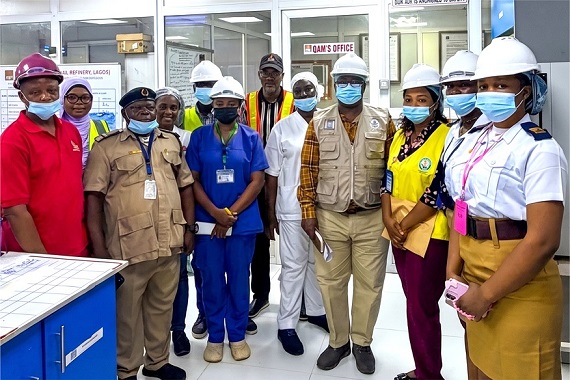
To have an efficient and effective Port Health system that safeguards quality public health services for all point of entry users.
Stay informed with the latest updates on global disease threats, travel protocols, and official directives from the Federal Ministry of Health and the Nigeria Centre for Disease Control (NCDC).
Routine structural risk assessments and exit/entry screening protocols have been heightened across all points of entry.

We actively engage border communities and stakeholders through sensitization campaigns, IEC (Information, Education, and Communication) materials distribution, and commemorations of global health days.